

There was a moment in Accounting this weekend when Prof. Lane began taking us backward.
Not literally, of course. We were still sitting in the same classroom, nearing the end of a course that had been part of our lives for nearly three months at Wharton.
But the slides began to look familiar.
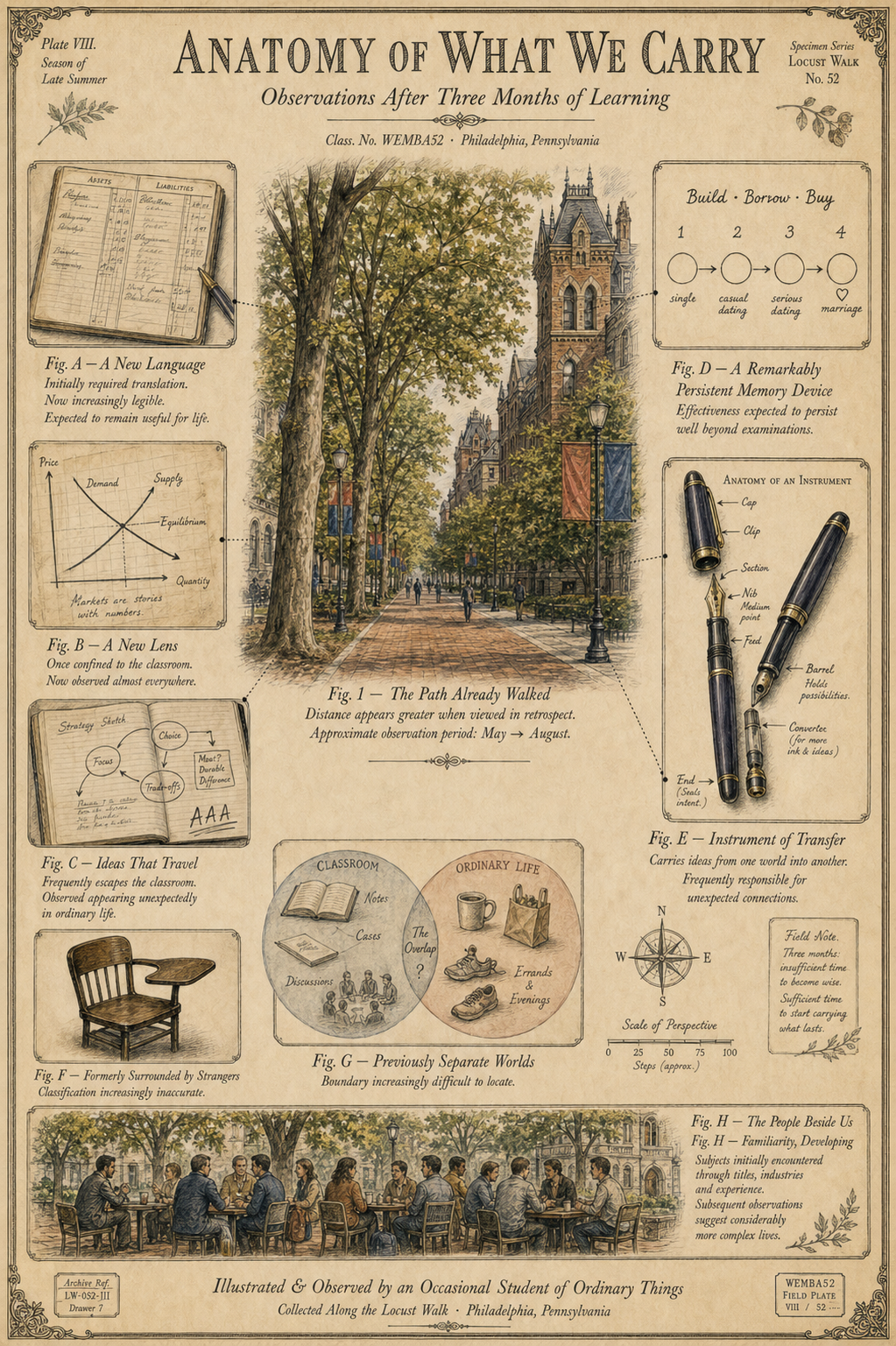
Concepts we had encountered weeks ago. Words that, in May, had required explanation before we could even begin to use them. The language of financial statements, assets and liabilities, cash flows, inventory, leases — things that had once required our full attention just to follow the conversation.
She had put together a set of slides to show us where we had started and how far we had come.
It felt a little like walking down memory lane.
Except the memories were only three months old.
Prof. Lane told us that this was something we would carry with us for life.
I don't know why that sentence stayed with me as much as it did.
Maybe because somewhere between trying to understand the accounting equation in May and being able to reasonably read a financial statement in August, I hadn't stopped to notice that something unfamiliar had quietly become a language I could speak.
And Accounting isn't the only place this has happened.
There was Microeconomics with Prof. Smetters, and somehow concepts that once belonged on a classroom slide now show up everywhere. In pricing. In choices. In incentives. In conversations with people who have never taken our class.
I can talk about microeconomics now.
More importantly, I can see it.
Prof. Siggelkow taught us Business Strategy, and I found myself carrying his frameworks so far outside the classroom that one of them eventually made its way into my writing. A framework intended to help us understand businesses became a way for me to examine the choices in my own life.
And now Prof. Hernandez is teaching us Global Strategy.
This weekend, somewhere between Aggregation, Adaptation and Arbitrage, my mind wandered again.
AAA isn't a sequence — something we were specifically warned not to confuse it for. Aggregation, Adaptation and Arbitrage are different strategic responses to navigating differences across markets, and companies may draw on one or several depending on what they're trying to do.
But as I sat with the ideas, my mind wandered somewhere else.
I started thinking about the different worlds we build in our own lives.
When something significant enters a life, sometimes we adapt around it. Routines change. Expectations change. The people around us adjust too.
Sometimes things that once belonged to separate worlds begin to cross between them. Something I learn in a classroom changes the way I think at work. Something I've experienced at work completely changes the way I understand a classroom discussion.
And sometimes the differences between those worlds are precisely what make the combination valuable.
I don't mean to turn AAA into a framework for living. It isn't.
But perhaps the fact that I couldn't leave it in the classroom is the more interesting thing.
The learning is traveling.
Prof. Hernandez does this deliberately sometimes. While teaching Build-Borrow-Buy, he gave us a wonderfully unexpected way to remember the continuum:
I love being single. Casual dating. Serious dating. Marriage.
Build. Borrow through contracts. Borrow through alliances. Buy.
It was funny, simple, and remarkably effective. I suspect years from now, some of us will still remember Build-Borrow-Buy because of it.
Maybe that's what good learning does.
Some of it teaches us things we didn't know.
Some of it gives us a new lens for things we thought we already understood.
And some of it finally gives us language for things we've been experiencing for years but couldn't quite explain.
Three months into Wharton, I am beginning to realize how many new languages and lenses I'm already carrying.
But this weekend, I noticed something else.
It was Family Day.
Until now, I have known most of my classmates within a very particular context. We arrive every other weekend with our professional lives attached to us. Titles. Industries. Companies. Experiences. Opinions. The things we've built and led and solved.
And then their families arrived.
Spouses. Partners. Children.
Suddenly, people I had known in one dimension became fuller somehow.
There was something unexpectedly lovely about it.
These are the people we sit beside in Accounting and Economics and Strategy classes, but they also have entire lives waiting beyond those classroom doors. Children who want their attention. Partners who know versions of them that we don't.
My own worlds crossed that day too.
My husband was there. My kids were there. They met the people whose names have entered our conversations at home. They ate the food, played with the balloons, did the scavenger hunt and happily occupied this place that, until now, has mostly been somewhere Mommy disappears to every other weekend.
And I loved watching them there.
Perhaps even more surprising was that I loved being there too.
Before I arrived, I had the familiar thought:
Oh no. Another social gathering.
Crowds and parties aren't usually places where I expand. I tend to retreat into myself a little. I find the people I know. I stay within the comfortable edges of the room.
Except this time, I didn't.
I talked.
I met families.
I found myself wanting to know people beyond the versions of them I already knew.
And somewhere during the evening, I realized I wasn't waiting to leave.
That was different.
I don't know if Wharton is changing me, yet.
It feels far too early — and perhaps a little too dramatic — to declare that after three months.
But we are now two weekends away from finishing our first term.
And when I turn around toward May, I can see the distance.
Back then, Accounting was a language I didn't speak.
Economics was something I understood far less clearly than I thought I did.
Strategy was something businesses did.
The people around me were mostly strangers.
Wharton itself was still something I had chosen, rather than something I had lived.
Only three months have passed.
Sometimes, walking along Locust Walk, I still get that little flash of disbelief:
I'm here.
I am actually here, learning from these extraordinary professors, surrounded by people whose lives I am slowly getting to know, studying things that are already changing the way I see the world outside the classroom.
I don't know yet what all of this will become.
There is still so much road ahead.
But sometimes, on Locust Walk, I can turn around and almost see the person who arrived here in May.
And I know this much.
I'm already carrying things I didn't arrive with.
Some of them, I suspect, I will carry for life.