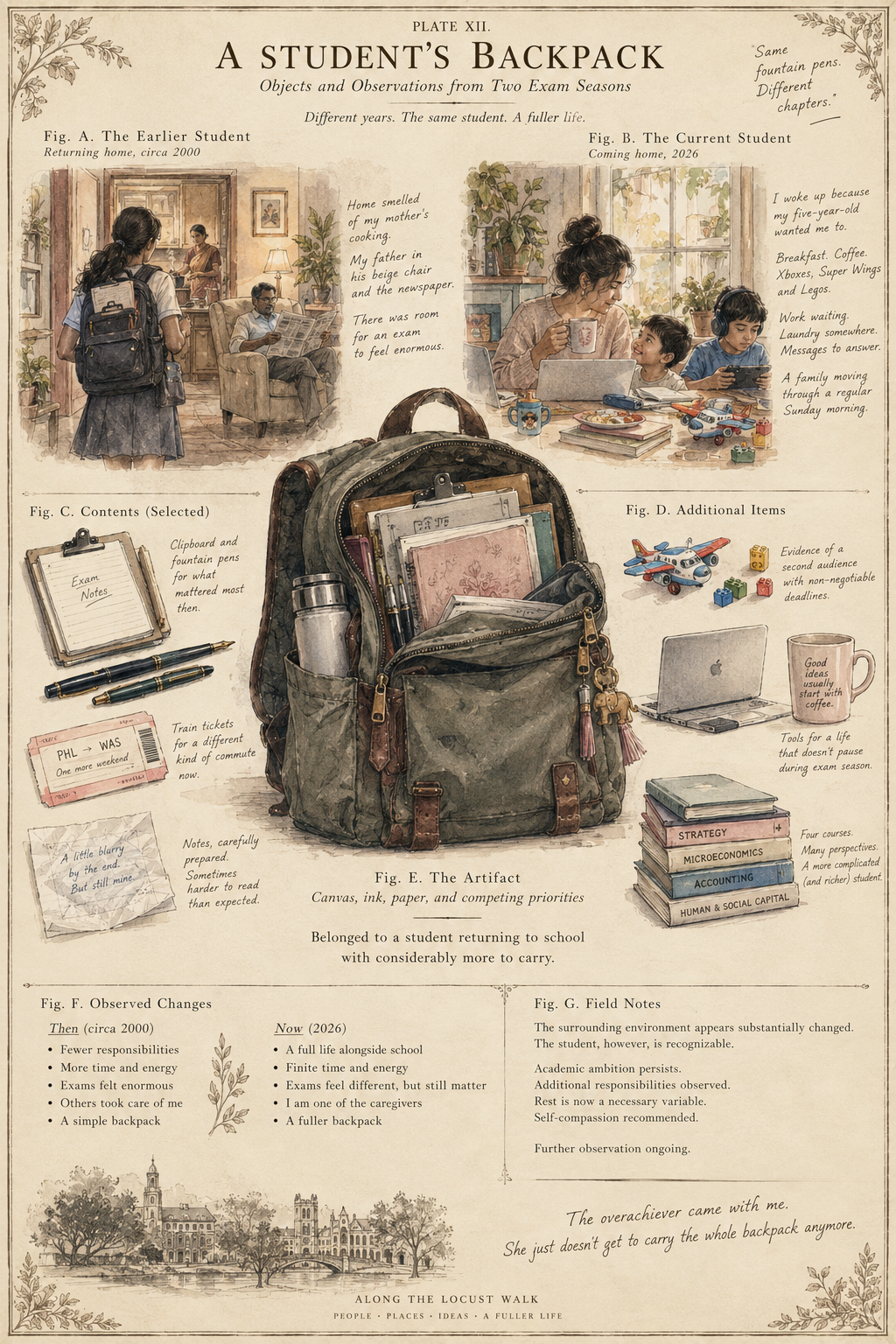


When I was in high school, I would walk home after an exam with my clipboard tucked into my backpack and several fountain pens I had used that morning rattling around inside.
Home would smell of whatever my mother was cooking. My father would be sitting in his favorite beige chair, leisurely reading the newspaper. I would walk in carrying the entire importance of that morning's exam with me — the questions I had answered, the ones I wasn't sure about, the marks I hoped I hadn't lost.
At seventeen, there was room for an exam to feel enormous.
A few weeks ago, I came home from an exam very differently.
My brother picked me up from the train station. I was so exhausted that I fell asleep in the car on the way home. By the time we arrived, everyone had already gone to bed. I crawled quietly into bed beside my five-year-old and slept.
The next morning, I woke up because my five-year-old wanted me to.
I made breakfast after a good cup of coffee. The children played around me — Xboxes, Super Wings and Legos scattered through the morning. There was work waiting for me. Laundry somewhere, probably. Messages to answer. A family moving through a regular Sunday morning.
The world still happened, just as it always did.
But something in me had changed.
I had just finished the first term of my MBA, more than two decades after I first learned what it meant to care deeply about doing well in school.
And somewhere between the student who once walked home with a backpack full of fountain pens and the one who now came home to children waiting for her, I had become a very different kind of student.
The problem was, the overachiever in me hadn't quite noticed.
The student who came with me
She still believed in the old formula.
Prepare enough. Work hard enough. Stay up a little longer. Go into the exam knowing that you have done everything you possibly could.
It had worked remarkably well for her before.
At seventeen, being a student was one of the biggest responsibilities I had. Even when I went back to graduate school at twenty-six, life had a different shape. There were fewer things competing for the same finite reserves of time, attention and energy.
This time, I arrived at school with an entire life already in progress.
I have a full-time career that does not become less demanding because I have an exam coming up. I have two children whose lives continue regardless of what is on my syllabus. There is a marriage, a home, people I care about, responsibilities I cannot simply put on hold.
And then there is my body.
That was perhaps the part I underestimated most.
During finals week, I kept staying up late to prepare. There was always one more concept I wanted to review, another problem I wanted to work through, another little bit of confidence I thought I could buy at the cost of another hour of sleep.
My body apparently had other ideas.
By the time I sat down for my exams, I was exhausted.
I remember looking at my cheat sheet — the sheet I had spent so much time preparing — and realizing that it had become a blurry mess. I had to work to focus my eyes on what I had written. Things I knew felt harder to retrieve. Logic that I could apply perfectly well while studying suddenly required effort.
I had prepared my mind for the exam.
I had not prepared the body carrying it.
And the body won.
Afterward, I could barely remember what had happened inside those exam rooms. Accounting was reduced in my memory to coconuts, thanks largely to my friend Marie reminding me about them. Microeconomics left me with drones.
Coconuts and drones.
Three months of learning, apparently filed away by my exhausted brain under two completely inexplicable nouns.
Then the grades came
I went home and did something I should probably have done before the exams.
I rested.
For almost an entire week, I let my body catch up. I went back to work. I spent time with my family. Life resumed its normal rhythm.
And slowly, the exam results began arriving.
Accounting came first.
That one hurt.
My midterm had gone much better, and seeing how much my performance had fallen on the final was difficult. I knew exactly what that exam had felt like while I was taking it. I knew how exhausted I had been.
Knowing why didn't make the score easier to see.
Then came the course grades.
Those were harder still.
There is something strange about encountering a version of yourself you thought you had outgrown.
I am old enough to know that a grade is not a verdict on my ability. I have worked long enough to know that nobody is going to ask me, years from now, what I scored on an Accounting final. I came to Wharton for the learning, the people, the exposure and the experience — not to collect letters on a transcript.
I knew all of that.
And I was still upset.
The overachiever, it turns out, is remarkably resistant to rational argument.
I wasn't accustomed to those grades. They sat with me in a way I hadn't expected. On the outside, life continued normally. I worked. I parented. I did everything I was supposed to do.
Inside, though, I kept returning to them.
Could I have studied differently?
Could I have prepared more?
Should I have done better?
It took me a couple of days to realize that perhaps those weren't quite the right questions.
Because yes, there were things I could learn about how I prepared. But there was another lesson underneath them that was much harder for me to accept:
I cannot ask the same things of myself at forty that I asked of myself at seventeen.
Not because I am capable of less.
Because I am responsible for more.
Going back
I wasn't alone in struggling with that.
As the grades came out, I talked with a few classmates. Some had their own disappointments. We had all arrived at Wharton with histories of doing well. You don't usually build demanding careers, raise families and then decide to add an Executive MBA to the mix without being accustomed to expecting a lot from yourself.
And then, almost before we had finished processing Term 1, it was time to return.
We walked back into Huntsman Hall for the first class weekend of Term 2.
Something shifted almost immediately.
We talked about grades. We talked about the exams. We laughed about parts of Term 1. We compared experiences. And then two new courses began, new ideas appeared on the screen, notebooks opened again, and we started learning.
The thing that had felt so enormous at home suddenly became smaller.
Not unimportant.
Just properly sized.
Sitting there again, I could see Term 1 as more than the letters that eventually appeared beside the courses.
The learning had been immense.
So had everything around it.
There were professors who had changed the way I thought. There were concepts that had begun finding their way into conversations far outside the classroom. There were classmates who, in a matter of months, had become people I could admit disappointment to. There were friendships, ridiculous exam questions, train rides, late nights, family adjustments, laughter, exhaustion and a great deal of figuring things out as we went.
A grade could tell me something about my performance on a course.
It couldn't hold all of that.
A different kind of student
I don't think the lesson from my first term is that I should care less about doing well.
I still want the A.
In fact, I suspect the seventeen-year-old with the fountain pens would be deeply suspicious of any conclusion that suggested otherwise.
But perhaps I am beginning to understand that achievement has to occupy a different place in my life now.
There will be times when another hour of studying is worth it.
There will also be times when the wiser choice is sleep.
There will be weekends when school gets most of me, and others when my children need more. There will be moments when work refuses to cooperate with the beautifully organized study schedule I had imagined. There will be exams where I perform exactly as I hoped and, apparently, exams that leave behind nothing but coconuts and drones.
Maybe doing this at forty isn't about proving that I can still be the student I was at seventeen.
Maybe it is about learning how to be the student I am now.
One who is ambitious, but finite.
One who can be disappointed without allowing disappointment to erase everything else.
One who can want to do better next time without turning the last result into a judgment of herself.
One who is slowly learning that knowing when to push is important — and knowing when to rest may be just as important.
I came home from those exams and crawled into bed beside my five-year-old.
The next morning, he woke me because, in his world, Term 1 had not just ended.
It was simply Sunday.
There was breakfast to make. Coffee to drink. Legos to build. A regular life waiting for me.
A few weeks later, I walked back into Huntsman Hall and opened my notebook for Term 2.
The overachiever came with me, of course.
I don't think she's going anywhere.
But perhaps this time, she doesn't get to carry the whole backpack.