

It took me almost a week after finals to write this.
Not because I didn't know what I wanted to say.
My brain simply seemed to have closed for maintenance.
After weeks of cases, late nights, review sessions, too little sleep, and two final exams, I apparently needed several days before I could think clearly again.
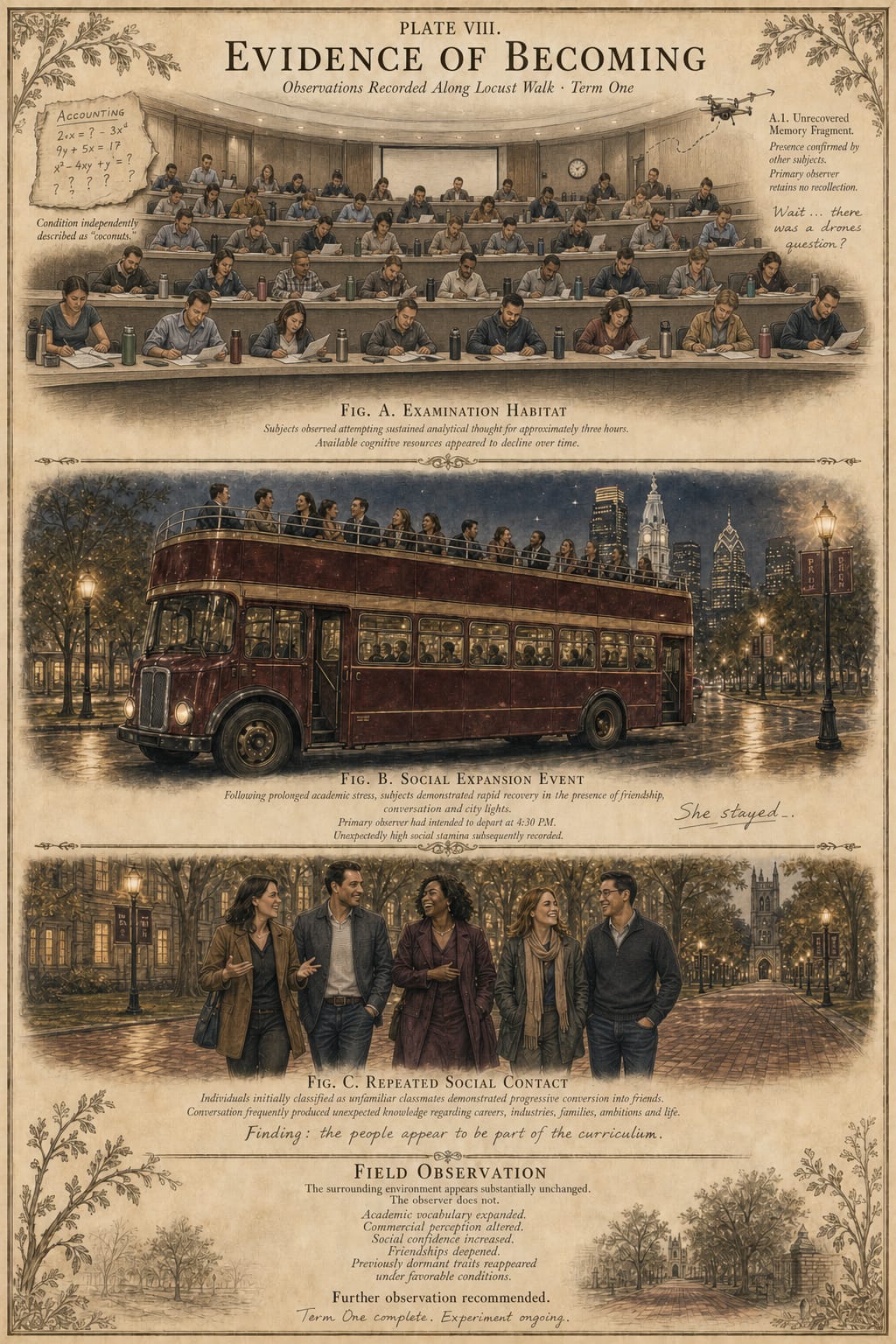
The Microeconomics final alone asked my brain to cooperate for three straight hours. By somewhere in the middle, it had other ideas.
A few days later, a friend asked me what I had done for the drones question.
“The what?”
“The drones question.”
Apparently there had been a question about drones.
I had taken the exam. I had presumably read the question. And yet, somewhere between the exam room and that conversation, the drones had completely flown away from my memory.
Accounting, the day before, hadn't been much kinder.
A friend summed that exam up perfectly:
“Accounting was coconuts.”
It was harder and more confusing than we anticipated, and by the time we walked out of our last final, there wasn't much intellectual capacity left among many of us.
And just like that, Term One was over.
Or at least the exams were.
A week later, I am not exactly resting. There is a team project due Monday, and ASML continues to reveal another layer every time we think we understand it.
But the exam fog has finally lifted.
And with a little distance, I can see the first term differently.
What I thought I came here to learn
Three months ago, we walked into Huntsman Hall with new notebooks, new names to remember, and some version of the question:
What exactly have I signed myself up for?
Then came accounting, economics, strategy, organizations, cases, frameworks, readings and conversations.
Slowly, something interesting started happening.
The things we were learning stopped staying in the classroom.
I look at brands differently now.
When a company creates a promotion or a pricing strategy, I find myself looking beyond the lure of the offer and wondering about the economics underneath it. When I see an interesting business, I start pulling apart its model.
Ideas I have had for businesses of my own now come with new questions: Where is the value being created? What would the economics look like? What choices would make this difficult to imitate?
Strategy has given me something else: language for things I had noticed before but couldn't quite articulate.
Someone gives the phenomenon a name. A framework. A way of thinking about it. Suddenly something that was fuzzy becomes easier to examine.
Perhaps that has been my favorite part of going back to school.
The world hasn't changed.
But I have a few more ways of seeing it.
I even find myself looking forward to reading books written by some of my professors—which is perhaps not something I expected to say immediately after finals.
But the academics are only one part of what changed.
The life around the classroom
Somewhere during these three months, the DC-to-Philadelphia train became familiar.
So did packing the little suitcase. Hotel rooms. Walking into Huntsman. Opening the laptop again when I really wanted to sleep.
Our families found new rhythms around the weekends we were away. Things that initially required planning gradually became ordinary.
And somehow, our capacity stretched.
Not unlimited capacity, as the three-hour Micro final rather decisively demonstrated.
But more than I knew I had.
Then there were the people.
The people are part of the education
At the beginning of the term, everyone was someone new.
Then small things started accumulating.
You sit beside someone in class.
You work through a case together.
You talk over dinner.
Someone tells you what they do for work. Then they tell you how they ended up doing it.
Another conversation wanders into family, a career decision, an industry you know nothing about, a business idea, or something completely ridiculous.
And gradually the people whose names you were trying to remember become people you look forward to seeing.
I've noticed a change in myself here too.
I find it easier to initiate conversations now. I can usually find some small piece of context to begin with and let the conversation go somewhere from there.
For an introvert, that hasn't always come naturally to me.
But perhaps there is something about repeatedly spending two very intense days together that accelerates friendship.
We learn together.
We get tired together.
And occasionally, we get to have fun together.
A lot of fun, as it turns out.
I almost went home at 6:30
After our last exam, I had every intention of doing what I normally do.
Go home.
My usual train would have taken me back around 6:30.
It had been a grueling week. I hadn't slept properly. The sensible thing was obvious.
But there was a party that evening.
For some reason, I decided to stay.
A few hours later, I was on the open top of a double-decker bus, riding through Philadelphia with my classmates, talking about absolutely nothing important and having an absurd amount of fun.
I hadn't had a night like that in years.
Before moving to the US, I used to be much more spontaneous. I organized events. I went out with friends. There was a playful, adventurous side of me that had gradually become quieter as life changed.
Marriage. Moving countries. Children. Work. Responsibilities. And perhaps my own introversion making it harder to build that kind of social circle again.
I don't think I consciously decided to leave that version of myself behind.
Life simply filled the space around her.
And then, fourteen years later, there she was.
On top of a bus in Philadelphia.
Apparently still perfectly capable of partying.
Possibly with improved stamina.
I eventually made my train home with approximately two minutes to spare—something that would ordinarily have caused me considerable stress and that, for reasons involving the festivities of the evening, did not concern me nearly enough at the time.
I made it.
I got safely into my brother's car on the other end and promptly fell asleep for the hour-long ride home.
It was wonderful.
What counts as learning?
This week, I happened to talk about all of this with a neighbor who completed an Executive MBA at Darden years ago.
When he described the experience he remembered, he didn't begin with grades.
He talked about going out after class. Restaurants. Bars. Hanging out with classmates. Friendships becoming deeper.
Stepping temporarily outside the responsibilities of ordinary life and simply enjoying being with people who were going through the same strange, intense experience.
He called it one of the best times of his life.
I understood exactly what he meant.
Every other weekend, I step into a slightly different world.
For two days, I am surrounded by people I probably would never have encountered otherwise. I hear about companies and industries and lives completely different from mine. I sit in classrooms with professors who make me reconsider things I thought I understood.
And somewhere in those weekends, I keep discovering versions of myself too.
Some I haven't seen in years.
Some I didn't know existed.
It has also made me reconsider how I think about grades.
I came into the program still carrying some of the old instincts of being a student.
Learn everything.
Prepare harder.
Get the A.
I still want to understand the material. I care deeply about learning it well.
But I am slowly accepting that extracting the highest possible grade from these two years isn't the only measure of what I take away from them.
Because there is another choice waiting after class.
I can finish dinner and go back to my room to read another case.
Sometimes I will.
Sometimes I probably should.
Or I can stay.
Stay for another conversation.
Walk somewhere for dessert.
Hear about someone's work, family, strange career path or business idea.
Laugh about the exam we just survived.
Let someone become more than the person whose name appears beside mine on a group assignment.
I am beginning to understand that this, too, is part of the education.
The people sitting beside us aren't simply the people we are going to school with.
They are part of what we came here to learn from.
Somewhere Along the Way
Three months isn't very long.
And yet, an extraordinary amount of life seems to have been packed into it.
There will be more difficult weeks, more cases, more trains, more late nights and certainly more exams. There may even be more questions that disappear completely from my memory after I answer them.
But I think I am beginning to understand how I want to spend these two years.
Learn deeply.
Be curious.
Take the academics seriously.
But also stay for dinner.
Have the conversation.
Get to know the person sitting beside me.
Occasionally take the later train.
And when someone suggests riding around Philadelphia on top of a double-decker bus after finals, perhaps say yes.
Years from now, I may not remember the grade I received on that first Microeconomics final.
At the moment, I can't even remember all the questions.
But I suspect I will remember the people.
The conversations.
The laughter.
The things I suddenly learned to see.
And that Saturday afternoon when I almost took the 6:30 train home.
But I stayed.
I came here expecting to learn a great deal.
Somewhere along the way, I started learning how much of the experience I could live.
And Term One was only the beginning.