

Some mornings, the page is quiet.
Not peaceful. Just quiet.
You sit down with a pen, and your thoughts feel scattered — unfinished conversations, half-formed worries, things you meant to say but didn’t.
You could scroll instead.
You could move on with your day.
But you stay.
And you write anyway.
Not beautifully.
Not insightfully.
Just honestly.
That is journaling.
Not the aesthetic version you see online.
Not the perfectly articulated reflection.
But the ordinary act of returning.
If you’ve ever wondered why journal at all — what the real benefits of journaling are — the answer isn’t dramatic.
It’s in the rhythm.
In the return.
Journaling is less about producing insight and more about practicing presence.
And presence, repeated daily, reshapes us.
The Benefits of Journaling Go Beyond “Getting It Out”
Many people begin journaling for emotional release.
And that’s valid.
Research on expressive writing — most notably the work of psychologist James Pennebaker — shows that writing about meaningful experiences, even briefly and consistently, improves emotional processing and overall well-being.
But the deeper benefit of journaling is not just catharsis.
It’s coherence.
When you journal regularly, you begin organizing your internal world. Thoughts that once felt chaotic start forming patterns. Experiences that felt overwhelming begin to settle into narrative.
The page becomes a place where your mind integrates.
And integration brings clarity.
Journaling for Mental Clarity
Unwritten thoughts swirl.
They interrupt sleep.
They replay during conversations.
They amplify themselves.
When you write them down, something subtle shifts.
Neuroscience research on affect labeling suggests that naming emotions reduces stress response — decreasing activity in the brain’s alarm center and increasing regulation.
What you can name, you can calm.
Journaling works not because it eliminates difficulty, but because it contains it.
The page becomes a container.
It signals:
“This has been acknowledged.”
“You are not holding this alone.”
You may not feel dramatically different after one entry.
But journaling daily builds a steadier baseline over time.
Memory Distorts; Writing Preserves.

Pattern Recognition: The Hidden Gift of Journaling Daily
When you journal occasionally, entries feel isolated.
When you journal consistently, patterns begin to surface.
You notice:
The same frustration resurfacing in different rooms.
The same energy drain after certain interactions.
The same idea returning month after month.
Your journal becomes lived data.
Research on structured reflection suggests that reflection transforms experience into insight and improves future decision-making.
Clarity reduces anxiety.
Instead of asking, “Why am I like this?” you begin to see when and why certain responses appear.
And awareness quietly shifts behavior.
Better Decisions Through Reflection
Repetition builds evidence.
You can look back and see:
“I’ve been uneasy about this for months.”
“I keep circling back to this idea.”
“I felt small in that room again.”
That repetition matters.
You learn from yourself.
And that learning builds confidence.
Emotional Vocabulary Builds Resilience
Fine.
Stressed.
Busy.
Journaling stretches vocabulary beyond those defaults.
You begin to differentiate:
Frustration from resentment.
Anxiety from excitement.
Fatigue from depletion.
The more precisely you name your experience, the more skillfully you can navigate it.
That is resilience.
Not suppressing emotion.
Understanding it.
Growth Becomes Visible
Personal growth is incremental.
Often invisible while it is happening.
But journaling records it.
You can look back and see:
How reactive you once were.
What you tolerated.
How your boundaries strengthened.
How your self-talk softened.
Memory distorts.
Writing preserves.
That is one of the deeper benefits of journaling daily.
It makes change visible.
Consistency Over Intensity
One page is enough.
Five minutes daily compounds more than occasional brilliance.
The power of journaling daily is not in depth.
It is in return.
For the Returning Reader
Keep returning.
The work is quiet, but it compounds.
For the New Reader
Lower the bar.
You do not need eloquence.
You do not need insight.
You do not need to feel ready.
Begin with one question:
What is taking up space in my mind today?
Write one page.
Then return tomorrow.
Begin Here
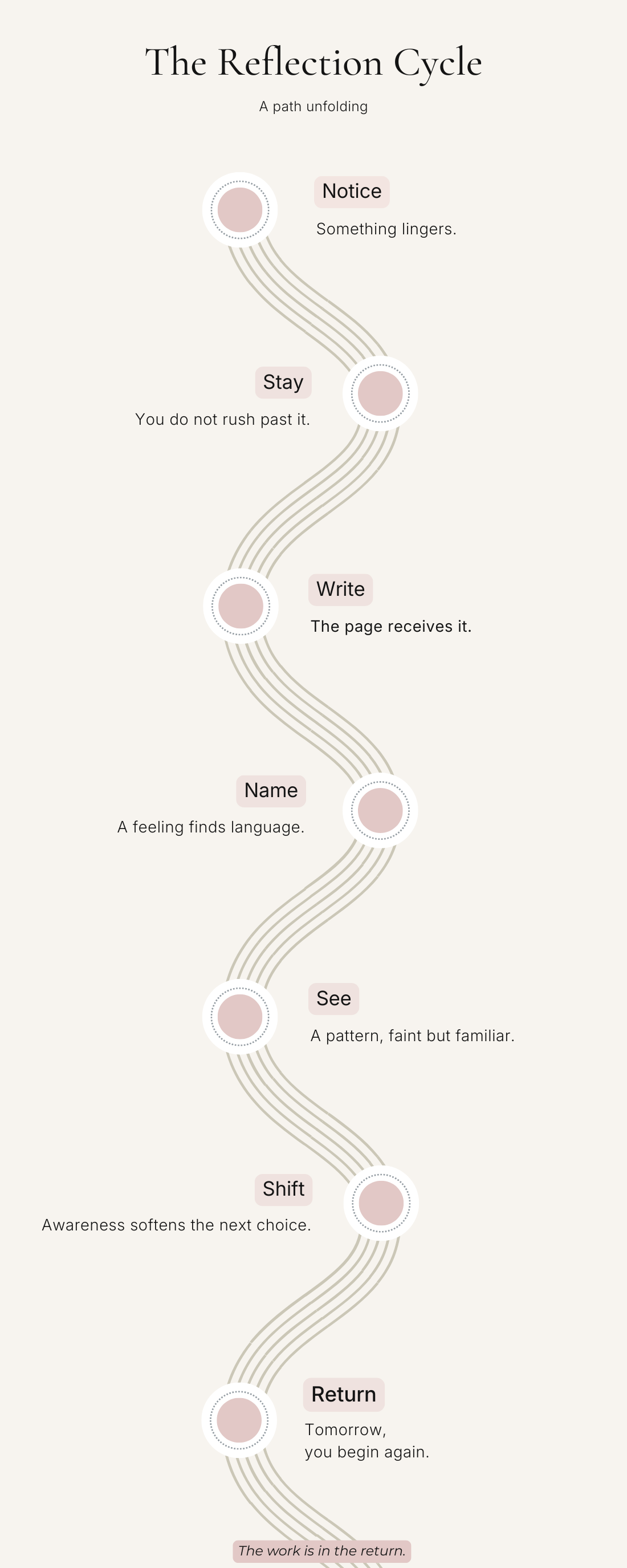
If you would like a gentle structure to begin, I’ve created a simple printable Journaling Starter Card built around the Reflection Cycle.
Download it, tuck it into your notebook, and start with one page.
Why Journal?
Because writing organizes the mind.
Because naming calms the nervous system.
Because patterns reveal themselves.
Because reflection improves decisions.
Because growth deserves to be documented.
But most of all —
Because journaling builds a relationship with yourself.
And relationships are built through consistent presence.
Even on ordinary days.
Especially on ordinary days.
The quiet work compounds.
You are not just filling notebooks.
You are becoming more honest with yourself.
And that honesty changes everything.
Further Reading
For readers interested in the research behind reflective writing:
Pennebaker, J. W., & Beall, S. K. (1986). Confronting a traumatic event: Toward an understanding of inhibition and disease. Journal of Abnormal Psychology.
Lieberman, M. D. et al. (2007). Putting feelings into words: Affect labeling disrupts amygdala activity. Psychological Science.
Di Stefano, G., Gino, F., Pisano, G., & Staats, B. (2014). Learning by thinking: How reflection improves performance.
If you’ve read this far, thank you for staying.
This space is for returning.
Not performing.
Not perfecting.
Just noticing.
Until tomorrow,
— One Inky Morning 🤍