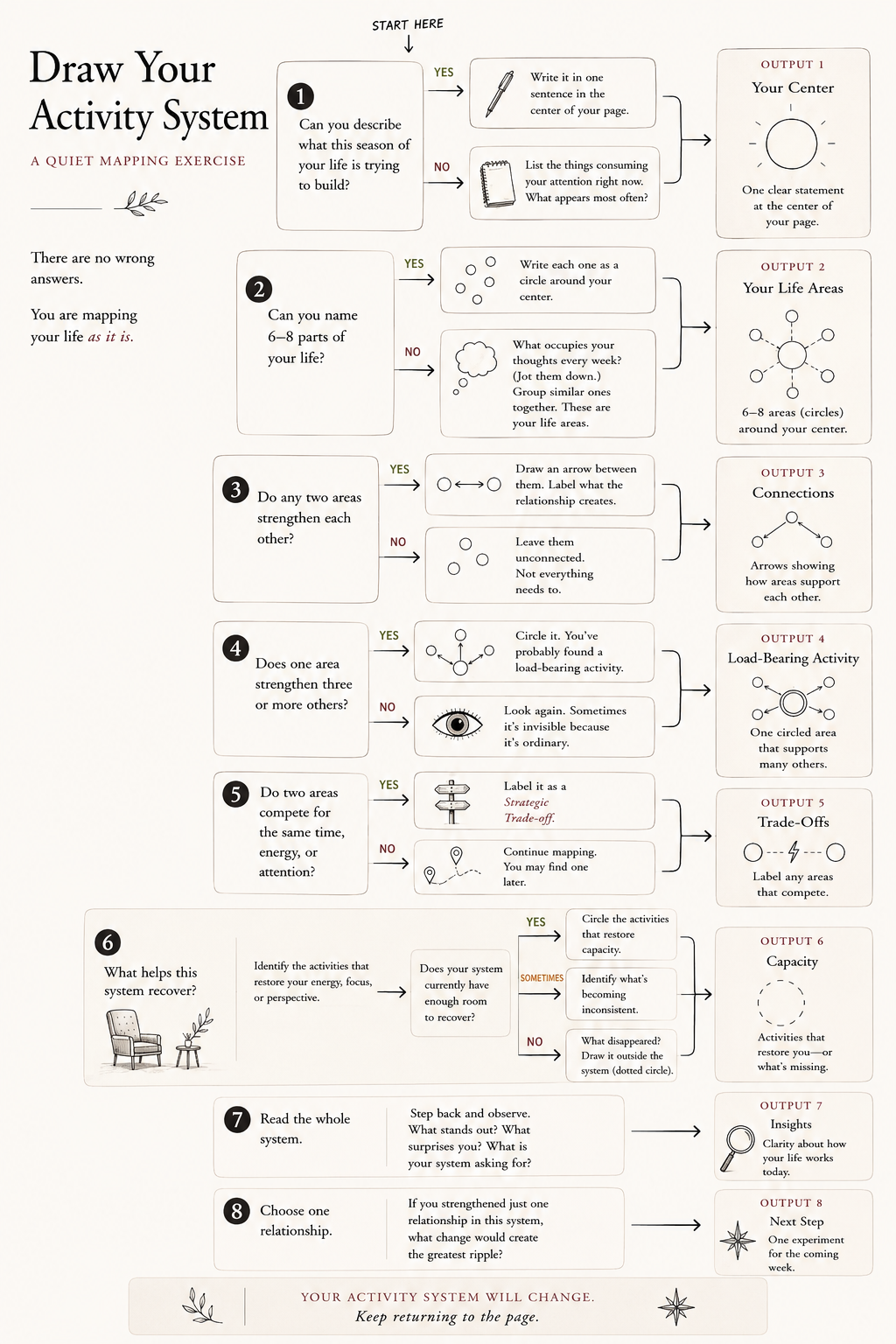


An activity system isn't something you invent. It's something you discover.
An activity system isn't something you invent. It's something you discover.
In the previous essay, I asked a simple question:
What are the reinforcing activities that quietly shape your own life?
This exercise is an invitation to explore that question on paper.
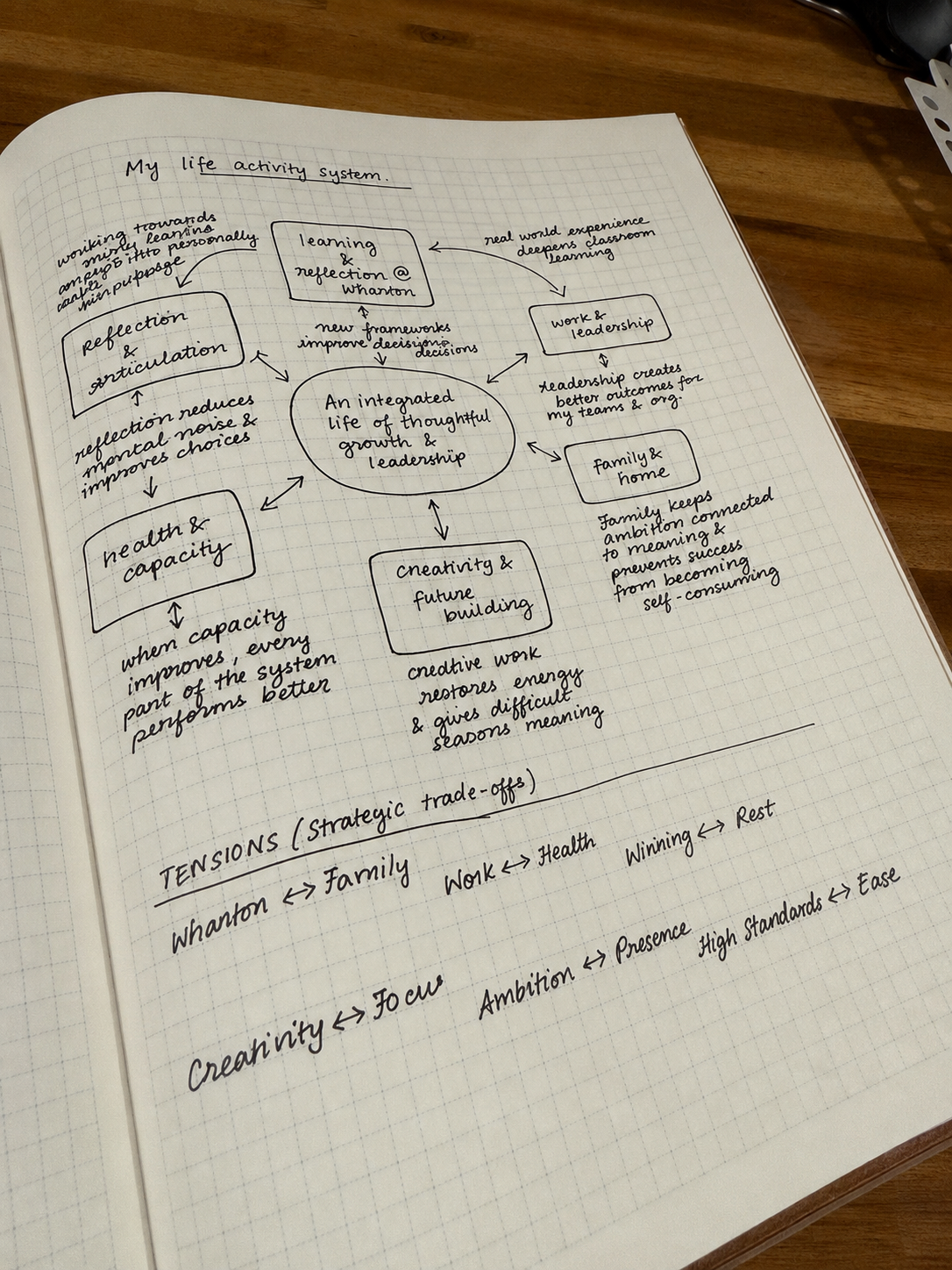
When I first drew my activity system, I wasn't trying to redesign my life.
I was trying to understand it.
I wanted to see what quietly held everything together, what had become strained, and which tensions were simply part of this season.
This exercise invites you to do the same.
There are no right answers. There is no perfect system. You're simply making the invisible architecture of your life visible.
Step 1: Find Your Center
Start with one question: What is this season of your life trying to build?
Try to answer in a single sentence. Not a mission statement — just something true.
If the answer doesn't come immediately, that's okay. List everything occupying your attention right now: projects, people, concerns, things you're hoping for. Then step back. The theme that keeps appearing is usually your center.
Draw one circle in the middle of the page. Write that sentence inside it.
Step 2: Identify Your Life Areas
Around your center, place six to eight circles representing the parts of your life that consistently receive your time, energy, or attention.
If nothing comes immediately, ask: What occupies my thoughts every week?
Group similar things together. Those become your areas.
They might be: work, family, learning, health, creativity, rest, faith, community, finances, friendships. Or something more particular to this season.
Step 3: Draw the Connections
Look at every pair of life areas and ask whether they strengthen one another.
If they do, draw an arrow. Label it with what the relationship actually creates — not what you wish it created, but what you've noticed it does.
Writing → Learning: turns experience into understanding.
Family → Work: provides perspective.
Health → Leadership: improves patience and attention.
If two areas don't meaningfully strengthen each other, leave them unconnected. Not everything needs to feed everything else.
But pause before moving on. Sometimes the absence of a connection is more revealing than the connections you've drawn.
If two areas should strengthen each other but don't — creativity that no longer restores energy, learning that never influences work — that gap is worth naming.
But don't only look for what's missing.
Ask yourself:
Which relationships in my life are stronger than I realized?
Sometimes the most important parts of a system are the ones we've stopped noticing because they've become ordinary.
You're not looking for a perfect web. You're looking for an honest picture.
Step 4: Find Your Load-Bearing Activities
Step back and look at the whole map.
Is there one area that strengthens three or more others? Circle it.
These are often the ordinary things: sleep, walking, reflection, family dinner, reading.
The ones you'd cancel first under pressure.
The ones whose absence quietly changes everything else.
If nothing stands out right away, look again. The most important part of a system is often the easiest to overlook.
Step 5: Name the Trade-offs
Not every relationship reinforces. Some compete.
Which two parts of your life regularly pull against each other for the same time, energy, or attention?
Work ↔ Health.
Family ↔ School.
Curiosity ↔ Focus.
Ambition ↔ Presence.
Label these honestly.
Then write beside them: strategic trade-off.
That distinction matters more than it might seem.
A problem asks to be solved.
A trade-off asks to be carried consciously.
Naming it doesn't make it lighter, but it makes it less lonely.
Step 6: Understand Your Capacity
Healthy systems don’t just produce output. They absorb shock.
In personal life, that capacity to absorb shock is slack—the unallocated buffer that quietly makes a life sustainable. When slack disappears, every commitment becomes load-bearing, and even a fifteen-minute delay creates immediate friction across the whole architecture.
Look at your map and ask yourself three quiet questions:
Where has the slack quietly disappeared?
Think back to a season when your life felt more resilient. What were the non-productive, unassigned spaces that held you up? An unscheduled Saturday afternoon wandering a bookstore. A quiet drive home without a podcast playing. Thirty unhurried minutes with morning coffee before checking messages.
If something that used to restore you has quietly vanished under pressure, draw it just outside your map in a dotted circle.
Not because you need to reclaim it immediately.
Just because it’s worth seeing.
Which relationships feed energy back into the system?
Look at the arrows connected to your daily routines. Differentiate between passive rest (scrolling, background noise) and regenerative slack (walking, journaling, quiet mornings, prayer, time in nature, or conversations with people who know you well).
Draw arrows from those restorative nodes back toward your high-demand areas. If your highest-demand areas have multiple arrows demanding your energy but zero incoming arrows feeding you back, your system is running on borrowed capacity.
Where does the structure snap?
Ask yourself: Where does my day break when life inevitably drifts off schedule?
If a late class, a delayed train, or a lingering meeting causes immediate strain on your sleep, your family, or your mood, you have located a point with zero slack. Name that boundary clearly on your page.
You cannot optimize your way out of a lack of slack. The goal isn't to schedule recovery like another task on an already full calendar. It is simply to recognize that a life, like any enduring system, requires room to breathe.
Step 7: Read the Whole System
Don't change anything yet.
Simply look.
Which connection surprised me?
Which activity quietly supports everything else?
Which tension have I been treating like a personal failure?
Where is this system stronger than I realized?
What is it asking for?
There is no score. Only understanding.
Step 8: Choose One Relationship
Resist the temptation to redesign everything at once.
Instead, ask: If I strengthened just one relationship in this system, which change would create the greatest ripple?
Not another habit. A stronger connection.
Maybe: protecting sleep because it improves your patience.
Journaling because it sharpens your decisions.
Family dinner because it reconnects the week.
Walking because it creates space to think.
Systems rarely change all at once.
They change one relationship at a time.
Your activity system isn't fixed.
It will change — with a new role, a move, a season of grief, a graduation, a child.
Each one rearranges the architecture. Come back to this exercise every few months.
Redraw the map.
Notice what has strengthened.
Notice what has faded.
Notice what has quietly become load-bearing.
Because the goal isn't to build someone else's life more faithfully.
It's to understand your own more clearly.
It is to understand the one you're already living — because once you can see it clearly, you can begin to strengthen it, one relationship at a time.
One Final Thought: when you finish, resist the urge to compare your map with anyone else's.
The purpose isn't to discover whether your life looks balanced or ambitious or successful.
It's to understand how your life actually works.
Some relationships will be strong.
Some will be missing.
Some tensions will define this season.
That's okay.
This map isn't a measure of how well you're living. It's simply a way of seeing more clearly.
So fold the page. Come back in a few months.
Draw it again.
Notice what has changed.
And perhaps more importantly, notice what hasn't.
If you want a structured template to fill out before transferring your system to your notebook, I've created an editable worksheet in Canva based on this exact architecture.
Open the Editable Life Activity System Worksheet on Canva
You can duplicate it to your own Canva account, customize the text and arrows, or print it out as a paper worksheet.